
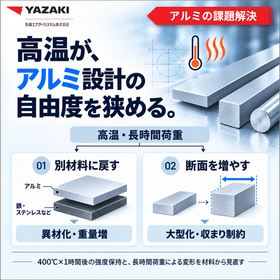
[Issue] Are you avoiding the use of aluminum under high temperatures and long-duration loads?
Returning only the high-temperature section to a different material and increasing the cross-section to account for deformation. Isn't that approach becoming a constraint on weight reduction and fit?
**Why does it become difficult to use under high temperatures and long-term loads?** Aluminum can lose strength when exposed to high temperatures or undergo deformation when subjected to continuous loads, depending on its material and condition. Therefore, it may be necessary to address this by changing only the high-temperature parts to copper or stainless steel, or by increasing the cross-section to account for deformation, which can complicate weight reduction and the fitting of components. **Are you postponing applications based solely on current judgment criteria?** Judging solely based on room temperature strength or a single temperature standard may not be sufficient to determine if it will hold up under actual usage conditions. It is important to separate and verify the residual strength after heating and the deformation when subjected to loads at the operating temperature. By organizing the necessary strength and allowable deformation in relation to temperature, load, and usage time, there may be opportunities to reconsider applications that were previously postponed. **For those who wish to proceed with consideration:** If you want to check the issues and evaluation points at hand, download the catalog "Aluminum: Organizing Constraints of High Temperature, Bending Processing, and Connection, and Expanding the Application Areas of Latest Technologies." For those who want to know more about the features of our aluminum composite materials, please refer to the article "Aluminum Composite Materials that Achieve High Strength, High Heat Resistance, Conductivity, and Workability."
- Company:矢崎エナジーシステム
- Price:Other
